


Growth and Changes, The Variations, The Troupes
With the socio-economic changes of the 19th Century, arts like Yakshagana also changed. The 19th Century produced a big number of compositions. Around 1800, a troupe from Dharmastala visited the court of the king of Mysore and established a troupe there. In the 1840s, a troupe from Uttara Kannada (North Kanara) visited Maharastra, and inspired the first modern age mythological drama by Vishudas Bhave. A number of troupes arose all over the Coastal Karnataka and probably in other parts of Karnataka too. By the early decades of this Century the structure of Yakshagana reached a definite shape and form.
1930s saw some changes in compositions, organisations and presentation. Dance and the spoken word was further developed and refined. But in costume, a type of degeneration started setting in due to the use of 'modern' clothing and stone jewellery, in place of handloom clothing and wooden ornaments.
The Year 1950 saw the birth of 'tent' troupes, giving performances to audience by tickets, with 'tent theatres' and furniture for seating. These troupes brought in commercialisation of Yakshagana, with both merits and demerits. Yakshagana saw major changes in form and organisation, electrical lights replaced the 'gas lights' or 'petromax' lamps. Seating arrangements improved. Major changes came in the themes, with the inclusion of folk epics, Sanskrit dramas and created (imaginary) stories forming the thematic base. Popular entertainment became the criterion in place of 'classical' presentation.
The North Kanara style of Yakshagana hitherto not know outside, started making a big impact on other styles. This trend continues even today.Along with all these, the traditional type of troupes, giving free shows financed by devotees still continue and have a very good support.
There are basically two variants of Yakshagana.
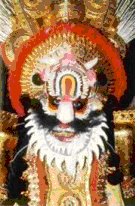 The Badagutittū style of Yakshagana
Tenkutittū
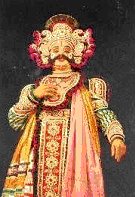 The Tenkutittū style of Yakshagana
The second variation, the Tenkutittū style, is prevalent in Southern areas of Tulu Nadu, that is, from Mulki to Kasargod.
The Troupes
Yakshagana is one of the most living art traditions in the World. There are about 30 full fledged professional troupes, and about 200 amateur troupes in Yakshagana. Professional troupes go on tour between November to May, giving about 180-200 shows that is, a full night show everyday!
There are about one thousand professional artists and much bigger number of amateurs. Further there are off season shows during the wet season, the anniversary shows, school and college students Yakshagana and of course the Talamaddale performances. All put together, we safely say that Karnataka witnesses about 12,000 Yakshagana performances every year!Yakshagana has not so far shown signs of quantity decline, in spite of very fast 'modernisation' and 'urbanisation'.
Yakshagana Puppetry
Another interesting facet of Yakshagana is the its use in puppetry. Evidence shows that there were more than 30 string puppet troupes in the undivided Dakshina Kannada district during the period 1910 – 1915 in places like Basrur, Barkur, Kokkarne, Mudabidri etc.
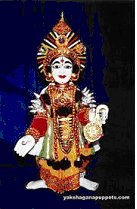 A typical Yakshagana Puppet
The puppetry in Yakshagana style is interesting as the presentation is highly stylized and adheres strictly to the norms and standards of Yakshagana. The puppets used are generally 18 inches high and the costumes are similar to those worn by the characters from Yakshagana with the same elaborate make-up, colourful head gear and heavy jewellery. The person who infuses life into the puppet and makes it come alive, by dextrous manipulation is known as the Suthradhara. The content in the Yakshagana puppetry, is drawn heavily from the ancient epics.
===================
Want fun then why wait? Click on any one of URLhttp://blog4people.coz.in http://jokes4children.coz.in http://adsense.coz.in http://kannada.coz.in http://ourmysore.coz.in http://wowbangalore.coz.in http://wowchennai.coz.in http://bhshistory.coz.in http://karaga.coz.in
posted by SaTiSh | 3:23 AM

0 Comments:
Post a Comment
<< Home